Integrating exudation into the root economics space to better understand carbon and nutrient cycling in managed grasslands
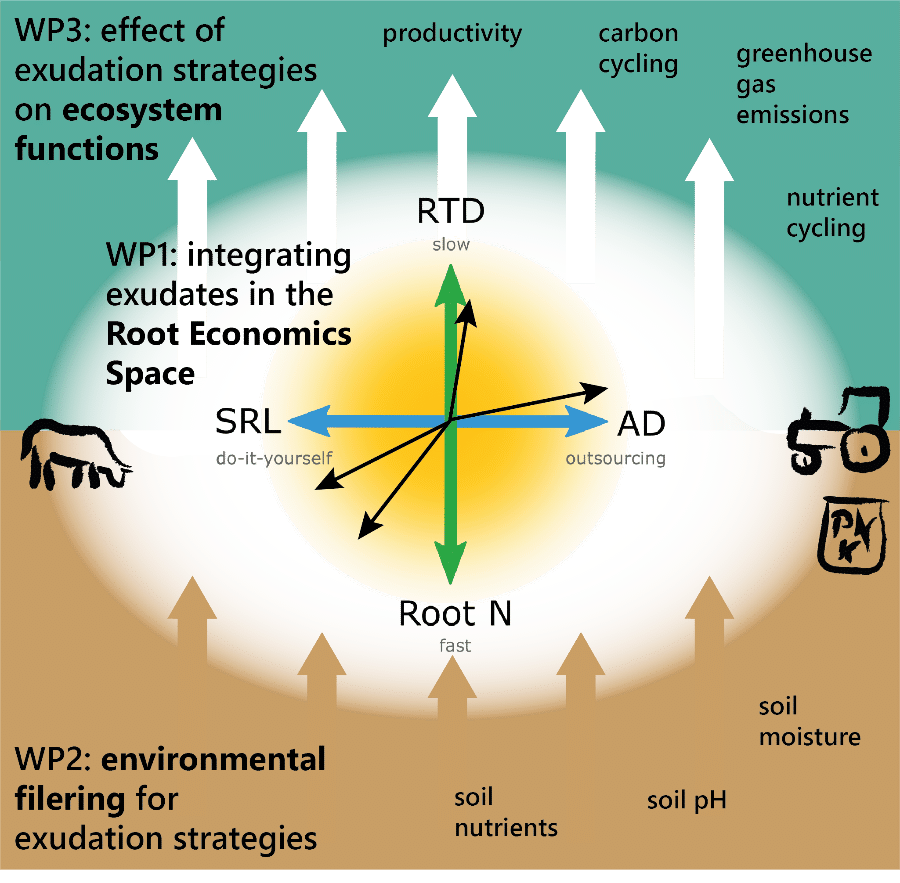

Root exudation is increasingly recognized as a key process in ecosystem functioning, but its integration into plant trait-based frameworks remains limited. Plant C investments in exudates have been linked to different economic strategies while clear conceptual understanding of positioning of root exudates in the root economics space (RES) is missing. With the aim of providing insights into C and nutrient cycling in managed grasslands, we aim to include root exudation into the existing framework of the RES. Understanding the role of root exudation in plant resource acquisition strategies and soil C dynamics is crucial in managed ecosystems such as grasslands, where intensive management practices such as grazing, fertilization and mowing strongly influence soil interactions.

- Determine root exudation patterns across a large set of grassland species from different functional groups to extend the concept of the root economics space.
- Test how environmental filtering, including land-use intensity and soil stoichiometry, shapes trait occurrences and community-level patterns of root exudation.
- Study how community-weighted root exudation traits influence key ecosystem functions such as greenhouse gas fluxes, C cycling, and plant productivity in managed grasslands.

- Root exudation rate and composition are affected by the conservation and collaboration gradient of the RES. Fast-growing and ‘do-it-yourself’ species will exhibit higher exudation rates and a dominance of labile C compounds to increase nutrient mobilization. Slow-growing species will release more specialized exudates, while ‘outsourcing’ species will show reduced exudation due to associations with mycorrhiza fungi.
- Nutrient-poor grasslands are expected to filter for more conservative and outsourcing species with lower overall exudation and a targeted release of specific compounds. Nutrient-rich grasslands will filter for acquisitive and do-it-yourself species with higher exudation rates to enhance nutrient mobilization.
- Community-weighted exudation traits influence ecosystem functions through interactions with microbial activity and nutrient cycling. Exudation of labile and N-priming compounds will show enhanced microbial activity, decomposition and greenhouse gas emissions while conservative communities with lower exudation rates promote slow efficient nutrient cycling and a potential for organic matter stabilization.

WP1: Integrating exudation patterns into the root economics space
We will conduct a large greenhouse experiment on about 80 grassland species most dominant in the grassland VIP plots of the BE to determine species specific exudation rates and composition, as well as the core fine-root traits known from the RES and mycorrhizal colonization. Exudates components include total exudation, carbohydrates, amino acids, phenolics and carboxylates. Data analysis includes phylogenetically informed GLMs for trait-trait relationships and phylogenetically informed PCA to integrate exudate traits with the core traits of the root economics space.
WP2: Effect of environmental filters on community exudation patterns
We will use vegetation survey data of the botany core project and soil nutrient analyses of the soil core project on EP level. We will calculate community weighted mean traits of exudation patterns to detect functional shifts and community traits variance to examine the strength of filtering. Further we will run this analysis for the 45 REX plots to examine soil environmental effects with and without land use.
WP3: Effect of community root exudation patterns on ecosystem functions
By integrating exudate traits into the RES on plant community level, we expect to increase the predictive power for several soil related ecosystem functions as well as for productivity. With various datasets on ecosystem functions and properties as part of the core synthesis project we will run analyses on EP level. Further we will use data on greenhouse gas emissions on REX-level to investigate the predictive power of community exudation patterns on greenhouse gas emissions.
Scientific assistants