Assessment and Ecosystem Functioning of Deadwood- and Airborne Saproxylic Microorganisms in Forests of Urban and National Park Areas


Saproxylic fungi and bacteria break down dead wood, releasing carbon dioxide and nutrients and playing a vital role in the forest’s nutrient cycle. These processes are complemented by symbiotic relationships between fungi, bacteria and/or algae (including lichens). Together, they contribute to nutrient cycling and increase biodiversity. However, they are sensitive to environmental changes and are considered important bioindicators of air quality and climate change.
Despite their central role, saproxylic microorganisms and lichens are rarely considered in forestry and nature conservation. In Central Europe, their species diversity is declining. In tropical forests, such as those in Taiwan, which are characterised by high tree species diversity and productivity, microbial diversity is particularly high. The composition of these communities is significantly influenced by the dominant tree species, land use and degree of urbanisation. Urban and peri-urban forests often have structural diversity and different management practices. These could prove to be important refuges for saproxylic microorganisms and lichens, as well as serving as biodiversity hotspots. However, to date, there have been no systematic studies on their role in urban ecosystems.

This project involves investigating forest areas with different management strategies, both within and outside cities, in Germany and Taiwan. The aim is to develop a deeper understanding of the ecological role of saproxylic microorganisms and lichen-forming fungi. The focus is on how their distribution, species composition and functional significance change under varying environmental conditions, and on the spatial dependence of these factors on each other. By analysing biodiversity patterns in relation to climate variables, land use types, and the availability of dead wood, we aim to identify the biological and ecological mechanisms shaping these organisms. Comparing temperate forests in Germany with tropical locations in Taiwan will also make it possible to determine the effect of climatic differences on microbial diversity, activity and decomposition processes.

Urban areas and adjacent forests are important habitats for wood-dwelling microorganisms and lichen-forming fungi. Their diversity and distribution are strongly dependent on the availability of wood and dead wood as well as the tree species present. Climate and environmental conditions also play a decisive role. A comparison between cities and forests in Germany and Taiwan could show that microorganisms spread in a similar way, but that their diversity and activity are influenced by climatic differences. In tropical regions such as Taiwan, the warmer and more humid environment is likely to drive higher biodiversity and faster decomposition of dead wood compared to temperate regions. The results will shed light on the distribution and importance of saproxylic microorganisms in their processes and ecosystem services in urban and near-natural landscapes.

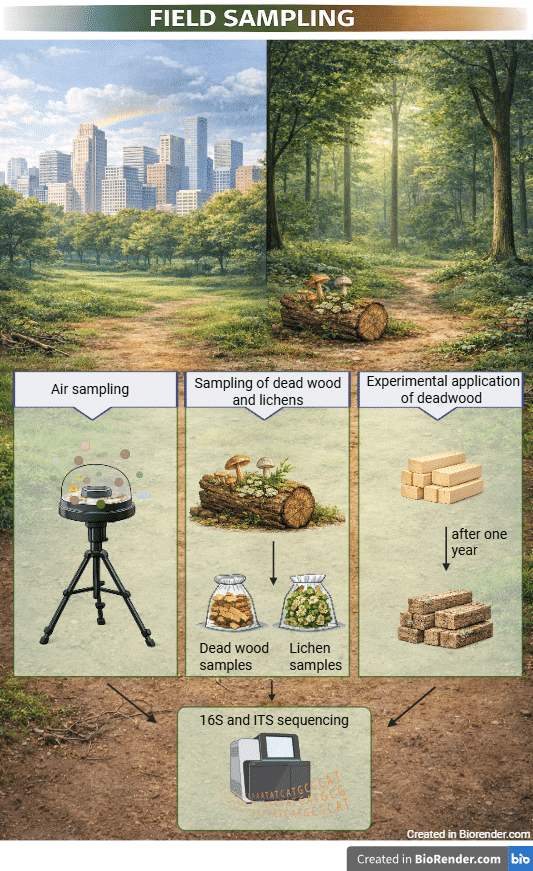
- Recording and documentation of deadwood: Deadwood with a diameter of more than 7 cm is located, photographed, and systematically recorded on site. The following data is documented: size; tree species; degree of decomposition; and accompanying data, such as weather conditions, occurrence and frequency of fruiting bodies and lichens. This data is then compared with previous surveys.
- Sampling of lichens and wood-dwelling microorganisms: Samples are taken from naturally occurring deadwood, such as fallen branches, tree stumps, standing deadwood trunks or trunks created by windthrow or forestry measures. Lichen thalli are collected directly from the surface, while wood-dwelling microorganisms are obtained from inside the dead wood by drilling (drill dust extraction).
- Site-specific data collection: For each site, information such as weather, altitude, tree species, their number and condition, forest size and structure, management practices, urban planning, degree of urbanisation, urban gardens, public infrastructure and anthropogenic activities is documented.
- Collection of airborne microorganisms: Air samples are taken at each location to determine the composition of fungal and bacterial communities in the ambient air.
- Exposure of standardised dead wood: Standardised, gamma-sterilised dead wood of the species European beech (Fagus sylvatica), English oak (Quercus robur) and Limba tree (Terminalia superba) measuring 25 × 50 × 500 mm is laid out for one year and then collected again to investigate colonisation and decomposition.
Scientific assistants