Biodiversity Exploratories – Diversity of Enchytraeidae and their Functions

Land-use intensity is one of the biggest drivers of biodiversity loss, but not all ecosystem degradation is visible to the bare eye. Landscapes can look healthy at the surface while soil biodiversity is quietly declining below the ground. This project explores this hidden side of land-use change by focusing on tiny soil invertebrates that most people have never heard of: potworms, or enchytraeids. It examines how land use affects the diversity of these soil animals, their functional diversity, and the consequences of community changes for soil functions.
Enchytraeids (Annelida, Enchytraeidae) are related to earthworms, but much smaller. They are up to two centimeters long and basically look like white miniature earthworms. But they are far more diverse and abundant than earthworms, especially in grasslands. They play a key role in soil formation and decomposition, but despite their importance, they remain surprisingly understudied. Enchytraeids are sensitive indicators of soil conditions like pH, moisture, and humus type, which likely has significant effects on community composition and functional diversity.
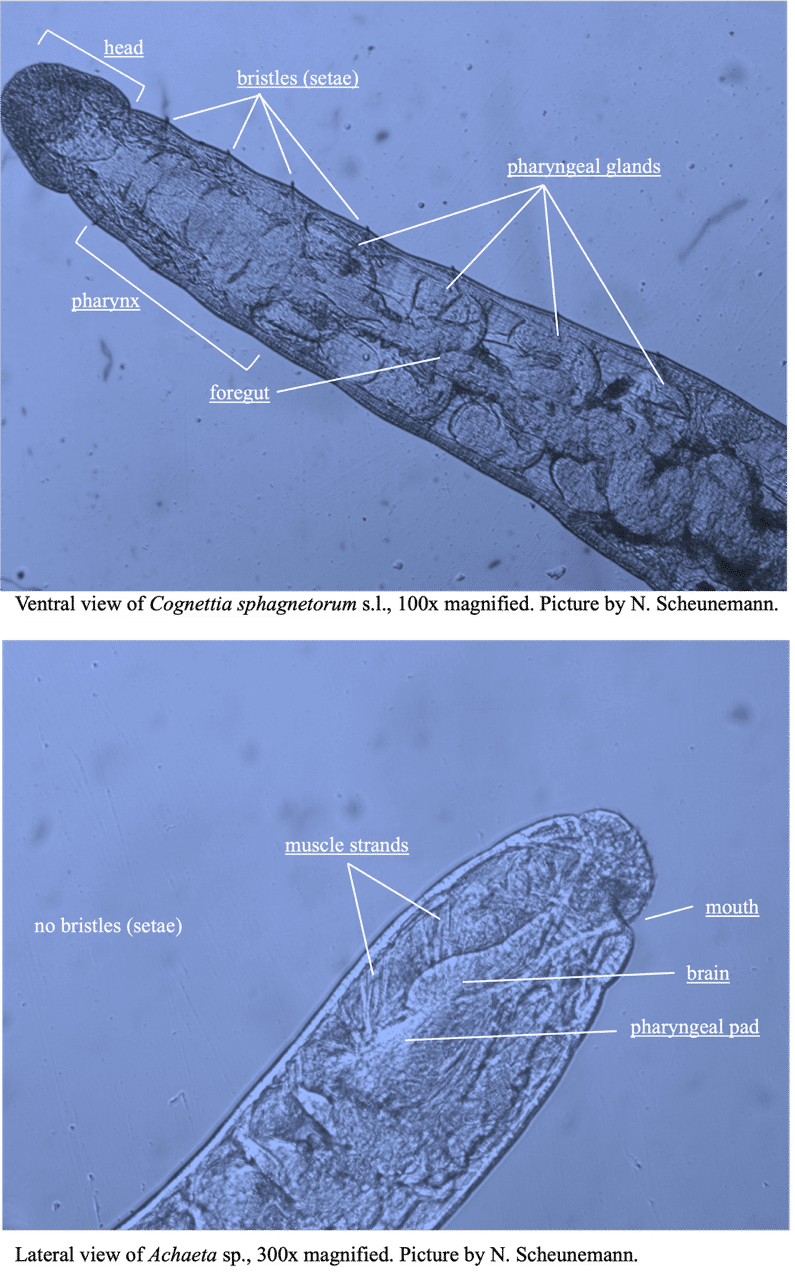

In this project, we will reveal how soil animal communities, represented by Enchytraeidae, respond to land use, and clarify the consequences of these changes for ecosystem functioning and soil health. We focus on the land-use gradient of all grassland plots and tackle this goal with three complementary approaches:
- First, we assess how land-use intensity changes biodiversity and community composition of Enchytraeidae.
- Second, we investigate how these changes affect functional diversity of Enchytraeidae, assessed via traits.
- Third, we study dynamics of the relationship of species diversity, functional diversity and land-use intensity over time to identify long-term effects of land use intensity on functional diversity and ecosystem functioning.
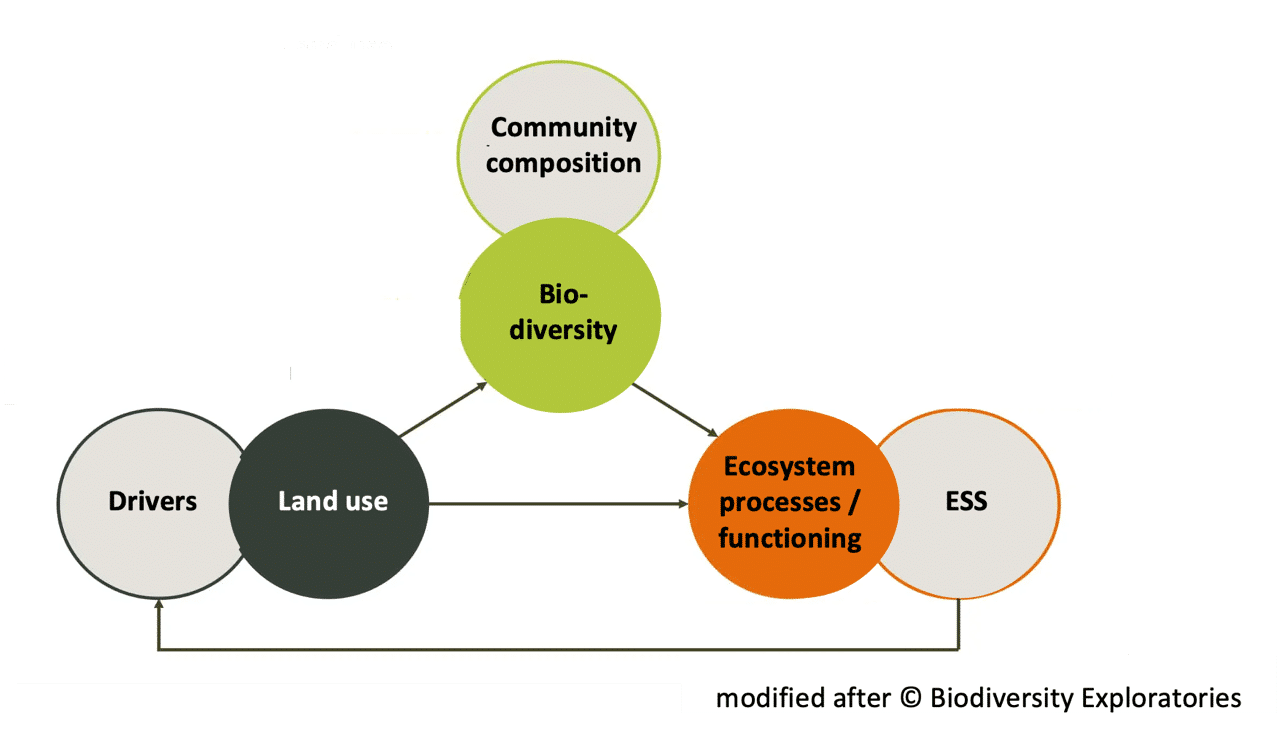

- We analyse the general effects of land use-intensity on diversity and test if land use filters species with specific trait combinations. We investigate diversity at genetic, species and trait levels.
- We test whether land-use intensity effects are stronger than regional differences. If they are, the trait combinations in different land-use systems will be consistent across regions, which allows us to generalize patterns we find.
- We will conduct a spatial analysis using data from previous projects (e.g. MultiBEF) to test whether more heterogeneous landscapes buffer negative land-use effects. In addition, we will link plot-level data on ecosystem functions (e.g. carbon storage), obtained in these earlier projects, with the functional diversity of Enchytraeidae.
- We analyse changes in community compositions and functional trait diversity during the past ten years to find out in which land-use systems Enchytraeidae and their provided ecosystem services recover fastest.
In the end, this project links land use, biodiversity, functional traits, and ecosystem functions.

We will take soil cores from all grassland EPs during autumn/winter 2026/27 and extract Enchytraeidae using the wet-funnel method.
DNA metabarcoding (comDNA) will be applied to extracted Enchytraeidae to track community changes and obtain species lists from all grassland plots.
Further, we track changes in the communities over time using eDNA samples from the past ten years (collaboration with Core project 8).
We use literature to obtain morphology-based traits of species.
We analyse proteome fingerprints and compound-specific stable isotopes in amino acids (CSIA, colaboration with LitterLinks2) to obtain new traits related to food resource use of Enchytraeidae.
We link metabarcoding species lists with species’ traits, and analyse the changes of species and functional diversity along the land-use gradient in space and time to infer the stability of Enchytraeidae-related ecosystem functions along a land-use gradient.
Scientific assistants