A multispecies genetic diversity survey for the Biodiversity Exploratories
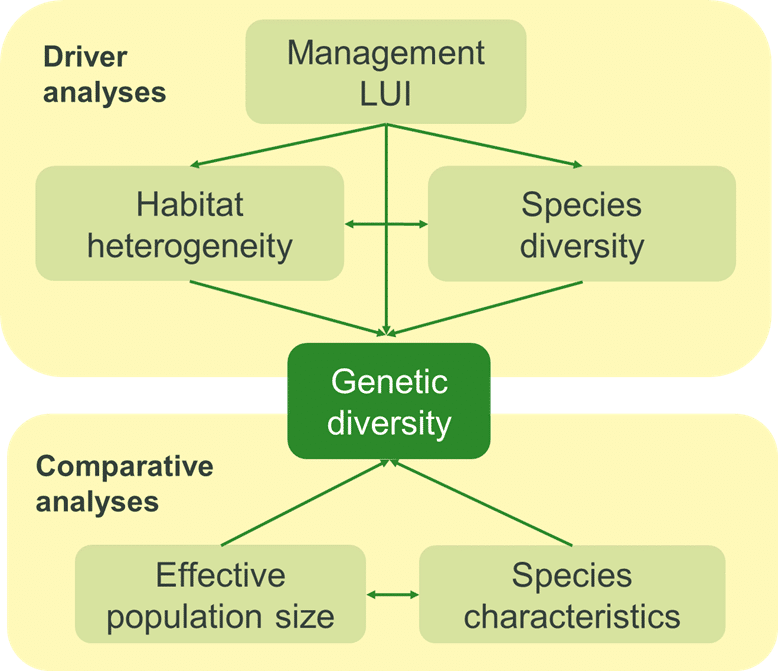

Genetic diversity is a fundamental level of biodiversity that reflects the evolutionary history of populations and determines their environmental sensitivity and adaptation potential. It is also a critical planetary boundary, and maintaining genetic diversity within and among species is a central goal of many biodiversity frameworks. However, there have been few large-scale and systematic studies of genetic diversity, and we lack information about the distribution and trends of genetic diversity, even among common species. The BEGenDiv project aims to characterize genetic diversity patterns for 90 of the Exploratories’ most common plant species and assess possible drivers of those patterns, such as LUI and environment. A final unsolved challenge among genetic diversity studies is how to aggregate genetic diversity data across multiple species, and we intend to tackle this through simulation, testing, and development of new across-species metrics. The results from this project could be the basis for future syntheses and provide a baseline for genetic monitoring, which is tracking changes in genetic diversity over time.

Our project will assess within-species genetic diversity for many of the most common plant taxa in the Exploratories, including 150 forest EPs and 50 grassland EPs. We will test the consistency of key drivers of genetic diversity across species and habitats, and evaluate the usefulness of effective population size as a universal genetic diversity indicator, while taking species’ characteristics into account. We will further develop standardized across-species metrics of genetic alpha and beta diversity.

- Hypothesis 1 | The impacts of land use on genetic diversity depends on the life history traits of plants, and they are higher in species with low dispersal ability and high habitat specialisation.
- Hypothesis 2 | Effective population size strongly depends on species abundances, gene flow distances, successional stage and temporal continuity, with rare and specialized species exhibiting smaller effective population sizes compared to more abundant generalists.
- Hypothesis 3 | Genetic diversity is higher in plots with greater environmental heterogeneity and lower management intensity, both for individual species and at the across-species level.

We will collect leaf material from the 18 most common tree species and 12 most common tree species in all forest EPs, and ~60 grass and herb species for all EPs in one Exploratory. We will perform SNP (single nucleotide polymorphism) genotyping using whole genome sequencing or ddRAD, depending on genome size and ploidy levels. This new data will be standardized and combined with existing genetic data from the Exploratories. From there we will test and develop cross-species metrics of genetic diversity, which we aim to associate with LUI and environmental factors.
Scientific assistants