Understanding the determinants and long-term dynamics of land use management on the methane sink microbiome biodiversity in grassland, forest and arable soils

Soils act as sinks and sources for the second most important greenhouse gas methane. Accordingly, both methane producing microorganisms, designated methanogens, and methane consuming microorganisms, called methanotrophs inhabit soils. Most upland soils act as a net sink but the potential to take up methane from the atmosphere depends on the type of land use and biodiversity of methantrophs. Forest soils take up most methane, followed by grasslands, where land-use intensity determines the uptake potential. In arable fields, in which involved microbes are affected by management practices the most, the methane sink potential is lowest. The Biodiversity Exploratories have by now documented biodiversity over a substantial period with changes in land-use and climate variables. This offers the opportunity to study methane microbial ecology among different land use types, specific management and restoration practices and to asses drivers of long-term dynamics in soils.

MetGrass II aims to understand how land-use reduction can lead to the restoration of methane sink activities in managed soils. We are specifically interested in management practices (e.g., mulching) and soil chemical parameters (e.g., copper) that modulate the grassland methane sink function and methantrophs and methanogens. Arable cropland – representing the most intensive land-use in the Biodiversity Exploratories – has often been gained from former land use types with high methane sink activity. We want to assess the impact of arable management practices on the methane sink potential. Beside land-use intensity as a major driver of biodiversity changes, ongoing climate change modulates biodiversity. We will thus use the unique long term (15 years) soil microbial taxa datasets of the Biodiversity Exploratories to disentangle long-term weather and land-use intensity changes on methane sink microbiomes.

- H1 Restoration of methane sink activity in formerly intensively managed grasslands is a long-term process. We hypothesize that after six years, methanogen abundance will further decrease, while reduced soil bulk density will promote atmospheric methane-consuming methanotrophs. This should be reflected in increased methane oxidation rates. However, likely still not reaching those of long-term extensively managed reference grasslands.
- H2 The diffusion of atmospheric methane into soil limits methanotroph activity. We hypothesize that a mulch layer from mown but unremoved grass reduces methane flux and stabilizes soil moisture, temporarily decreasing the methane sink. At other times, mulch decomposition may enhance microbial abundance, including methanotrophs, increasing methane uptake. Thus, mulching is expected to shift the methane sink and associated microbiome diversity depending on which effect dominates.
- H3 Management practices in arable soils can reduce methane sink capacity. We hypothesize that unmanaged field margins exhibit methane uptake rates similar to long-term grasslands, representing the near-optimal sink potential for these soils, whereas adjacent arable fields show diminished methane sink function.
- H4 Copper is a well-known and required micronutrient for methanotrophs enabling them to oxidize methane, since the active enzyme, that oxidizes methane (pMMO) requires copper to be functional. We hypothesize that grassland soils with a high copper bioavailability have higher methane oxidation potential and abundances of atmospheric methane-consuming methanotrophs.
- H5 Climate variables as topsoil temperature and water content have changed over the last decades in Germany. In the same period, the land-use intensity in some grasslands and forests has been changed by management practices. We hypothesize, that both have led to changes of the abundance of atmospheric methane-consuming methanotrophs in grassland and forest soils.

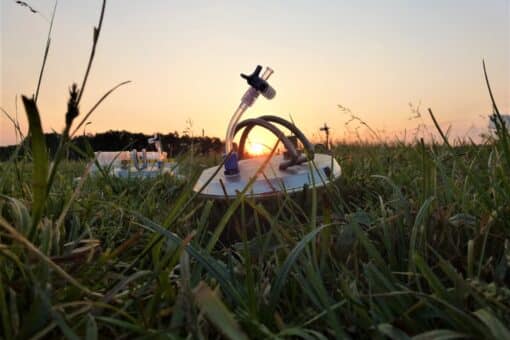
To quantify the abundance of different functional groups of methanotrophs and methanogens, we will use quantitative PCR (qPCR) of functional gene markers. The potential of these microbes to form and oxidize methane at different concentrations will be measured in soil incubations. In the joint multisite experiment REX1 we will employ this toolbox to investigate the effect of 6-year prolonged grassland extensification and to investigate the effects of a mulch layer which will be established on ten grassland plots of the Swabian Alb and at arable field sites for the comparison with their respective field margins.
We will measure soil copper fractions with different bio availabilities to identify such pools as drivers of methantroph biodiversity and to further select plots for in depth functional analyses of metagneomes by long-read sequencing. To disentangle long-term effects of changes in climate and land-use intensity re-extracted DNA from stored soil samples will be used to quantify functional gene markers.

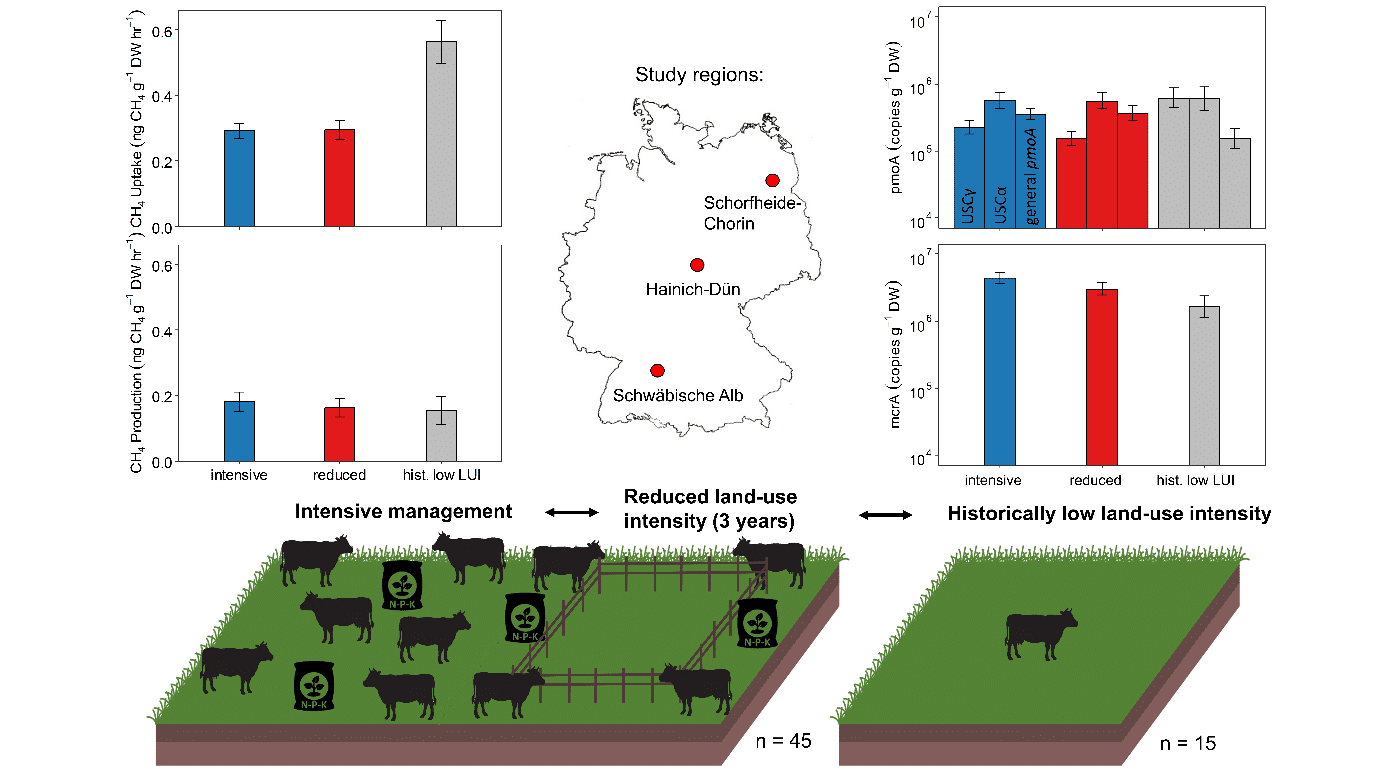
In the previous phase (MetGrass 2023-2026), we investigated the impact of a three-year experimental LUI reduction (no fertilization, no grazing, one mowing event per year; REX1 experiment) across 45 grassland sites, using 15 historically low land-use sites as a baseline. After three years, land-use intensity reduction had no significant effect on methane oxidation and production potentials as well as on methanotroph gene abundance (pmoA). In contrast, historically low land-use sites showed higher potential to oxidize atmospheric CH4 and greater Upland Soil Cluster γ (USCγ) methanotroph abundance, indicating the potential for long-term recovery of the atmospheric CH4 sink. Decreased methanogen gene abundance (mcrA), reduced soil bulk density and increased soil water content after three years highlight possible mechanisms that can mediate future recovery.
https://www.sciencedirect.com/science/article/pii/S0038071725002755
Project in other funding periods
Scientific assistants