Unravelling the relation between Values of Nature and Telecoupling

To contribute to sustainable land management, there is a need for understanding the societal drivers behind land-owners’ and land managers’ decisions that influence the provision of Nature’s Contributions to People (NCP). Drawing and expanding on the ecosystem service framework, the NCP framework explicitly acknowledges that these contributions are not only derived from nature but also require inputs from humans, a process known as “coproduction”.
In the previous phase of Biodiversity Exploratories, the research project entitled ‘Effects of land management on the Supply and Distribution of ecosystem services – ESuDis-’ operationalized the concept of NCP co-production in the three Biodiversity Exploratories study sites and linked the NCP co-production with the level of land-use intensity.
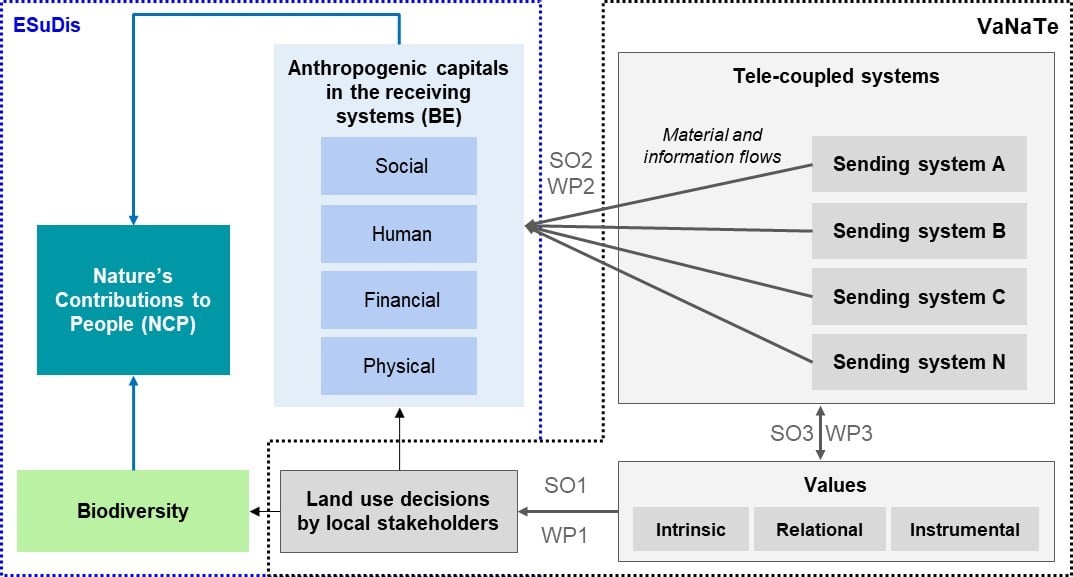
In VaNaTe, we will expand the focus of ESuDis by understanding the unknown interactions between two of the most important societal drivers that underpin land management: landowners’ and managers’ values of nature and NCP and telecoupling of NCP co-production.

- To understand the relationship between land-owners’ decisions regarding land management and their value-systems with regards to nature and NCP.
- To identify and characterise the telecoupling archetypes that underpin land-owners’ decisions with regard to NCP co-production.
- To gain in-depth knowledge of the feedback loops between telecoupling archetypes, values-systems, NCP co-production and land-management intensification.
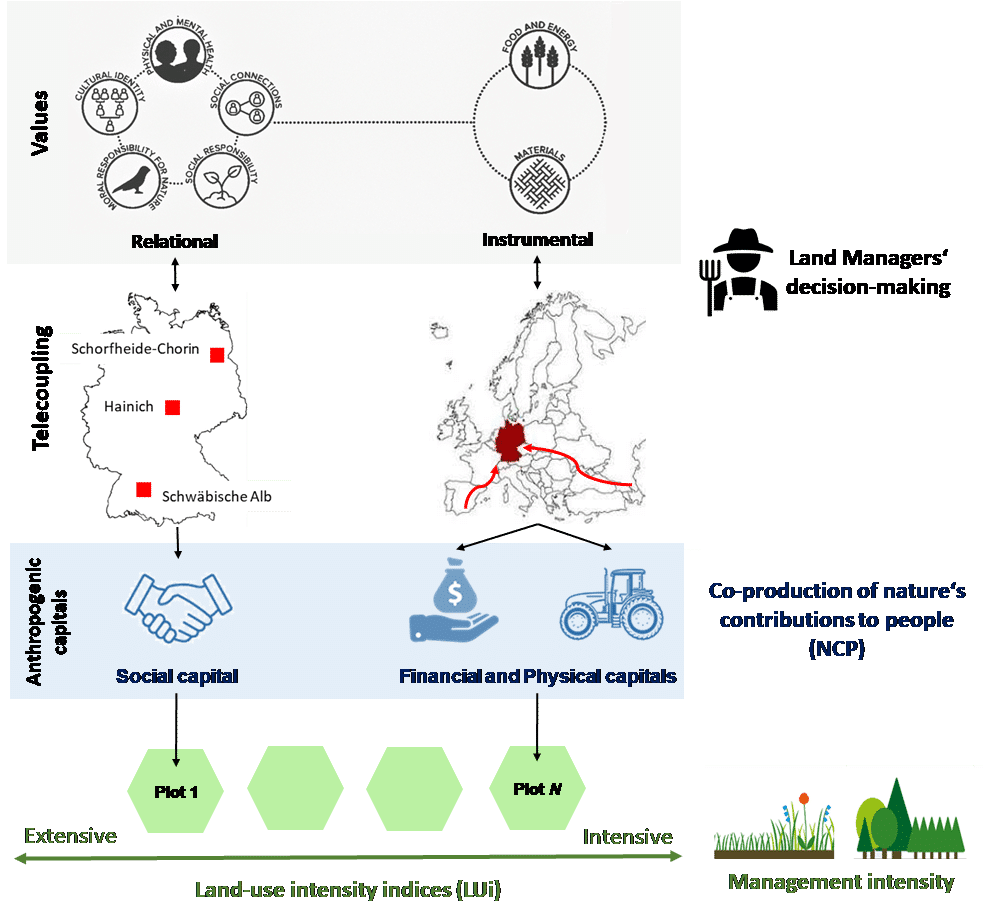

VaNaTe is organized in three working packages (WPs).
- WP1 seeks to elicit and spatially map values of nature and NCP expressed by landowners and managers through content analysis, photo-voice, surveys with a psychometric scale, multivariate statistics and participatory GIS.
- WP2 aims to identify and characterize archetypes of telecoupling of NCP co-production through content analysis, surveys, GIS, multivariate regressions and hierarchical cluster analysis.
- WP3 will disentangle the relations between telecoupling archetypes, values, NCP co-production and land-use intensity through a clustered heatmap analysis.

Scientific assistants