Plant diversity and plant-related processes
Auch in dieser Projektphase wird das Kernprojekt Botanik die Diversität höherer Gefäßpflanzen, Flechten, Moose und Pilze, die Produktivität von Grünländern und, in Experimenten, den Einfluss von Ausbreitungslimitierung und Störung untersuchen.
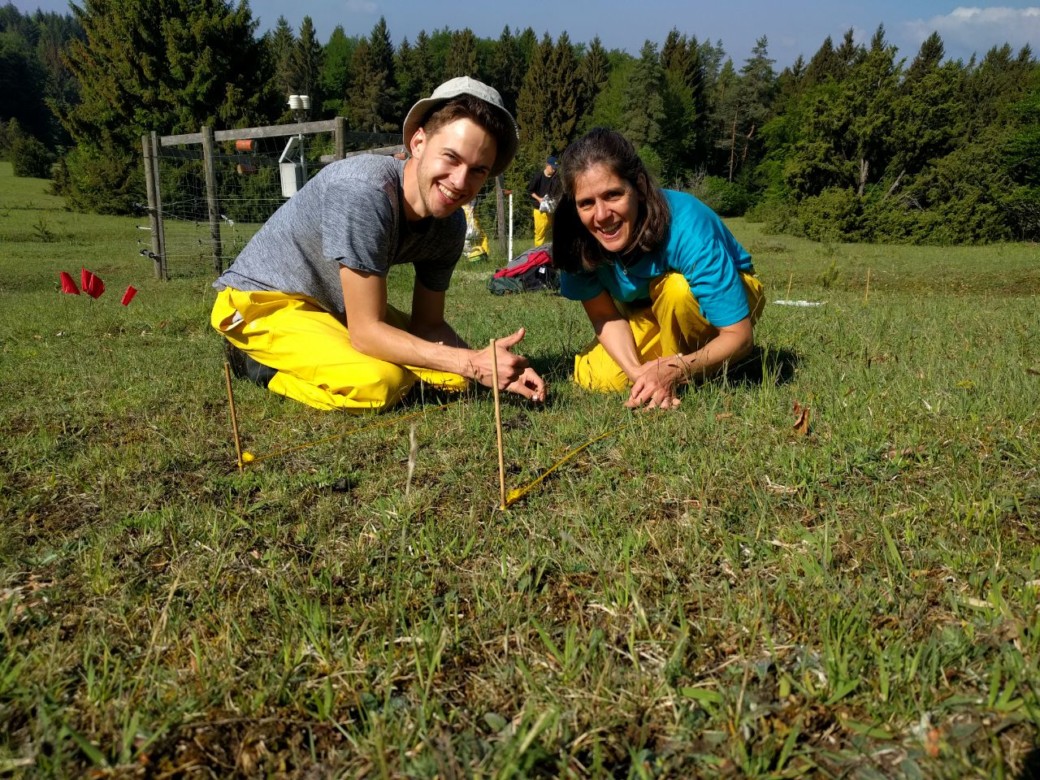

Since the beginning of the Biodiversity Exploratory program, the core project Botany examined the diversity of vascular plants, lichens and mosses in both grassland and forests, and as a major ecosystem process the productivity of grasslands. As primary producers, plants are fundamental to understand the effects of land use on ecosystem processes because many land-use effects will be mediated via changes in plant diversity with cascading effects through the entire food web.

The main goals of the present project are:
- to provide long-term data on the diversity of plants in grassland and forest to understand the effects of land use on plant diversity,
- to provide the aboveground productivity of grasslands as a major ecosystem process of plants,
- to provide the diversity and aboveground productivity on all agricultural fields as a major comparative ecosystem for plants
- to support the grassland experiments REX and LUX, which manipulate land-use intensity and propagule availability, and the forest gap experiment FOX, which created forest gaps to study the understorey vegetation and forest regeneration.
Moreover, the long-term data series of plant diversity and ecosystem processes allow us to estimate the stability of the community, regenerative capacity of communities after disturbances, and temporal trends in community composition as well as the abundance of individual species. Together with the vegetation monitoring, these data provide important baseline information for other projects, as many taxa and ecosystem processes will be directly or indirectly influenced by plant-related changes.
All core projects provide important basic information on land use, diversity and ecosystem processes (long-term monitoring). This information is made available to the sub-projects in each phase for research on more in-depth questions.
Services in the current phase
In the 8th phase (2026-2029), the core project Botany provides basic information on:
- Forest vegetation monitoring in spring and summer on 20 x 20 m on all EPs and in the FOX experiment
- Grassland vegetation monitoring in spring on 4 x 4m on all EPs and in the REX/LUX experiment
- Vegetation height on all grassland EPs and in the REX/LUX experiment
- Biomass production in grasslands on 1 x 1 m on all EPs and in the REX/LUX experiment
- Vegetation monitoring and biomass production on all agricultural fields
- Plant species functional characteristics and temporal trends for further in-depth analyses
Services in the former phases
In previous phases, the core project Botany also provided basic information on:
- Bryophyte diversity on all grid plots in 2008/9
- Lichen diversity on all grid plots in 2008/9
- Foliar fungal pathogen diversity on all grassland EPs in 2012
- Deadwood fungal diversity on all forest EPs in 2012
- Estimation of dispersal limitation on all grassland MIPs in 2012 and 2019
- Phenotypic plasticity of selected grassland species measured in a common garden in 2012
- Soil seed bank analysis on all grassland MIPs in 2015
- Plant diversity in the large-scale SADE-experiment in 2015-2019 and 2021
- Estimation of intraspecific trait variation of the ten most common species in all EPs in 2017/18
- Biomass production in the forest understorey on all forest EPs
- Soil seed bank on all forest plots and in the FOX experiment

Experimental Plots
Analyses of the vegetation monitoring showed, that land-use intensity reduced grassland diversity and increased productivity. While diversity was mainly affected by mowing intensity, productivity was affected by fertilization and soil conditions. High land use intensity led to a more species-poor but stable community composition in grasslands, whereas communities varied more over time at low land use intensity. A relatively small proportion of grassland species showed significant temporal trends. Positive trends were correlated with higher seed mass in graminoids (but not in herbs), indicating an increase in species with higher competitive ability (Bolliger 2024). Analyses of species-area relationships (SAR) in forests and grasslands revealed that the slope of the species-area relationship yields additional information about land-use effects on biodiversity that is missed by concentrating on species richness alone (Bolliger et al. 2025).
In forests, management had a positive effect on plant diversity, mainly driven by management-related disturbances, e.g. logging trails. Among the species promoted by forest management were mostly light-demanding species in the understorey, whereas typical forest species responded more negatively to forest management. While overall plant diversity of the study plots did not change over the last 15 years, diversity within plots varied strongly across years because of either windthrow or logging.
The first assessment of plant diversity on arable fields in 2024 revealed that, as expected, the number of plant species was much lower on arable fields than in grasslands, but in the same order of slightly more than 10 species per 16 m² in forests. Further analyses on community composition and ecosystem processes can be conducted with this newly established data in the future.
Multi-site experiments
The core project Botany is involved in setting up and maintaining the large land-use experiments in grassland (REX/LUX) and forest (FOX).
Results after 4 years of experimentally reduced land-use intensity in grasslands (REX) showed that plant diversity and biomass production have not yet changed in response to any of the treatments (Schreiner et al. 2026), in contrast to results from arthropods (see Staab et al. 2025). This indicates that high land-use intensity shows a pronounced legacy effect and restoration of plant diversity on former high land-use intensity plots requires years of extensification. Only the seed addition treatment in REX increased plant diversity, confirming findings from the previous SADE experiment.
In forests, the FOX-experiment was established to examine the effects of two main resources for forest organisms (light and deadwood) on diversity and ecosystem processes. The botany core project assessed the understorey vegetation and the soil seed bank. We found that increased light availability in gaps increased species richness and Shannon diversity whereas adding deadwood did not affect the soil seed bank. However, the effect of gaps varied depending on region (no differences in Schorfheide-Chorin), highlighting context dependency of effects and the need for regionally replicated experiments (Martinelli 2024).
Plant-related integration
Long-term vegetation data enables integrative analyses of diversity-productivity relationships. In cooperation with the core project Synthesis important findings were made concerning spatial and temporal diversity trends as well as community stability in terms of species composition and productivity.
Analysing temporal (time series) and spatial (across plots) beta diversity revealed congruent directions of the responses to land-use intensity. However, the magnitude of the effect was much smaller using the time-series compared with the spatial gradient. This indicates that, temporal changes in land use and associated diversity were much smaller than spatial variation. It further highlights the importance of long-term data series across a range of sites to document changes in diversity in a real landscape (Neuenkamp et al. 2025).
Studying the effects of functional trait diversity on community stability revealed that traits associated with an acquisitive strategy (e.g. high specific leaf area) were particularly important for compositional stability (Sperandii et al. 2024).
Examining community stability in relation with extreme climatic events, we found that the resistance of grasslands to extreme drought (change in biomass production after an extreme drought event) was higher in species-rich grasslands, while species-poor grasslands were more resistant to moderately dry conditions. These results underline the importance of plant diversity for the stability of ecosystem functions in response to climate change (Bazzichetto et al. 2023).
Full references to publications with participation of the core project Botany can be found below.

Public Datasets

Non-public datasets
Project in other funding periods
Scientific assistants