Effects of land use and climate change on the stability of plant communities and its underlying mechanisms
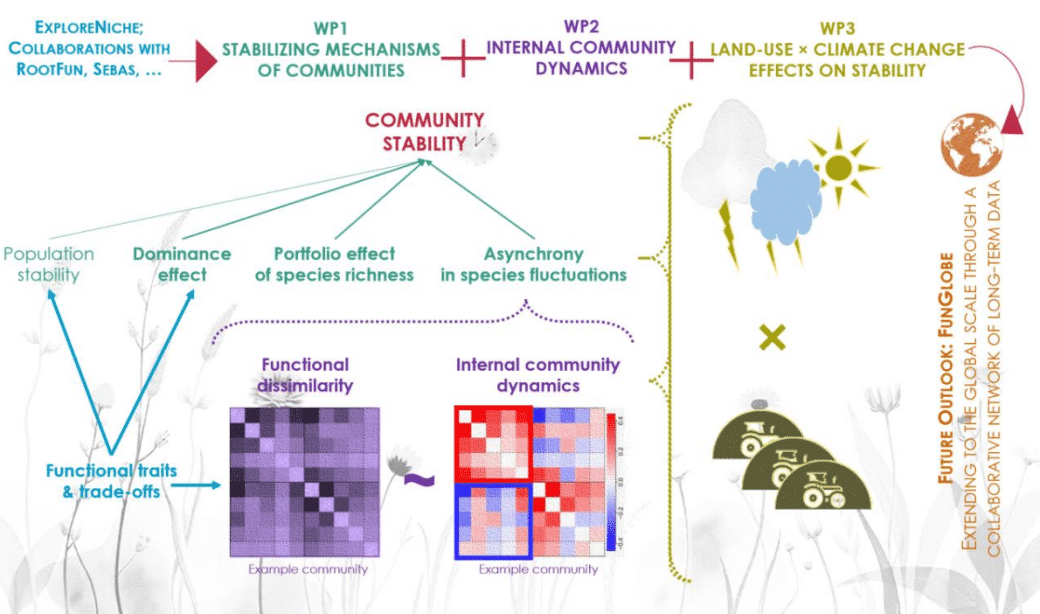

Temporal stability of plant communities maintains key ecosystem functions such as productivity and carbon sequestration despite inter-annual environmental fluctuations. Debates continue on the importance of the stabilizing mechanisms (dominance effect, portfolio effect of species richness, and asynchrony) and their links to functional traits. Interactive effects of land use gradients and extreme climate events remain poorly understood. The Biodiversity Exploratories provide a unique setup with 300 long-term plots (19 years of data) across grasslands and forests for this study.
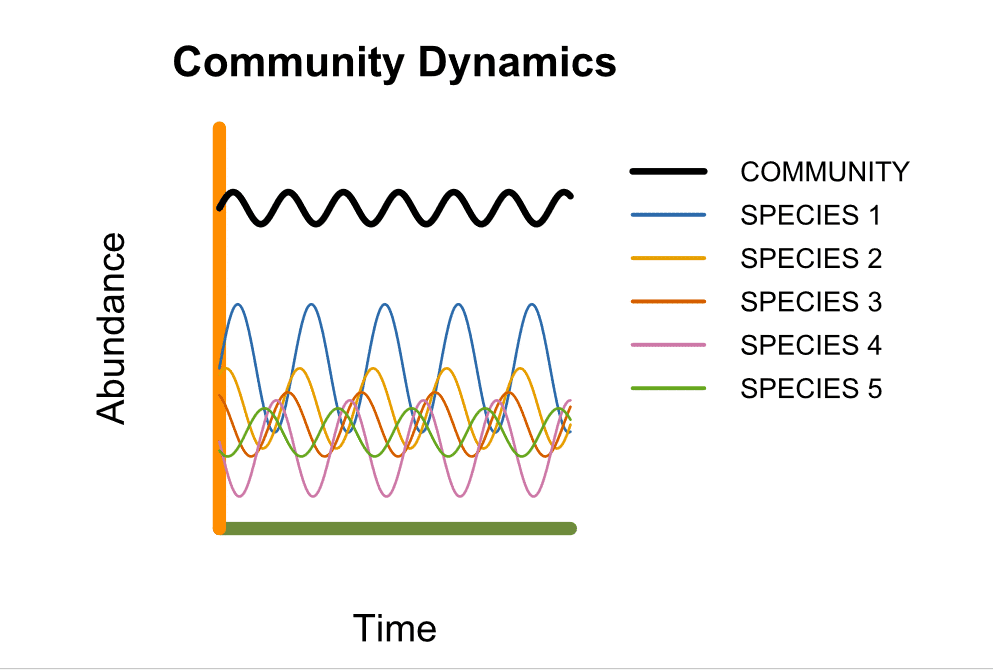

Quantify relative importance of stabilizing mechanisms (dominance effect, asynchrony, portfolio effect of species richness). Identify internal community dynamics via clusters of synchronous/asynchronous species and link to functional dissimilarities using machine learning. Evaluate interactive effects of land use and extreme climate events on stability and mechanisms.

- Dominant species with conservative resource strategies (above- and belowground traits) stabilize communities; acquisitive dominants destabilize them.
- Portfolio effect strengthens with species richness; asynchrony, especially compensatory dynamics, enhances stability.
- Internal dynamics mix synchronous (environment-driven) and asynchronous (competition-driven) covariances, predictable via functional traits/dissimilarities.

No new sampling: integrate BExIS datasets—vegetation abundances (Core Project 5), leaf/root traits (SeBAS/TRY, RootFun/GRooT), land use (LUI, mowing/grazing/fertilization/logging), extreme events (Core Project 10)—across all 300 EPs (Hainich, Schwäbische Alb, Schorfheide-Chorin).
- WP1 (Mechanisms): Partition stability via comstab R package; quantify dominance/portfolio/asynchrony; link dominants to traits.
- WP2 (Dynamics): Decompose asynchrony into pairs of asynchronous/synchronous species; predict their covariances from Euclidean trait distances using Mantel test using ecodist package
- WP3 (Drivers): GLMMs/SEM/machine learning for land use × event effects on stability/metrics; separate grassland/forest analyses.
Scientific assistants